














How Autonomous Cleaning Supports Airports and Stations
Airports and stations do not get the luxury of slowing down for long. Floors need to stay clean, safe, and presentable in environments where footfall starts early, moves quickly, and rarely stays predictable for long. For cleaning teams, that creates a difficult balance between maintaining standards, responding to mess in real time, and doing it all without disrupting the flow of passengers.
In transport environments, those pressures are even more visible. Airports, train stations, and transport hubs need round-the-clock cleanliness across large, high-traffic spaces while keeping disruption to a minimum.
In this blog, we will look at why cleaning standards matter so much in airports and stations, where traditional cleaning models can struggle, and how autonomous cleaning can support safer, more efficient operations in these high-footfall environments.
Why Cleaning Standards Matter More in Transport Environments
In airports and stations, cleanliness is highly visible and directly connected to passenger experience.
A clean concourse, terminal floor, or waiting area does more than look well-maintained. It affects how safe the environment feels, how professionally the space is perceived, and how confidently operators can keep public areas in use throughout the day. In transport, cleanliness is part of operational trust.
This is why transport sites tend to have a different cleaning challenge from smaller commercial environments. The issue is not simply whether the floor gets cleaned. It is whether that can happen consistently across large spaces, at busy times, and without creating unnecessary disruption for passengers or staff.
The British Cleaning Council notes that client organisations across both public and private sectors are trying to reduce spend while labour and materials costs continue to rise, pushing providers to find more efficient ways to deliver services. It also highlights increasing investment in data, digital technologies, sustainability, and robotics as part of that response.
How Autonomous Cleaning Supports Daily Operations
The value of autonomous cleaning in transport is not that it replaces the cleaning team. It is that it supports the team in an environment where consistency, coverage, and timing are difficult to maintain manually across every hour of the day.
A robot can take on repeatable floor care across large areas, allowing staff to focus on reactive cleaning, detail work, washrooms, public touchpoints, and the tasks that need judgment or direct human attention. That creates a more balanced use of labour rather than forcing teams to spend the same amount of time on repetitive floor coverage every day.
It also helps create more predictable cleaning performance. In high-traffic transport settings, repeatability matters. A cleaning model that is easy to document, schedule, and track can support stronger operational control than one that relies entirely on manual coverage.
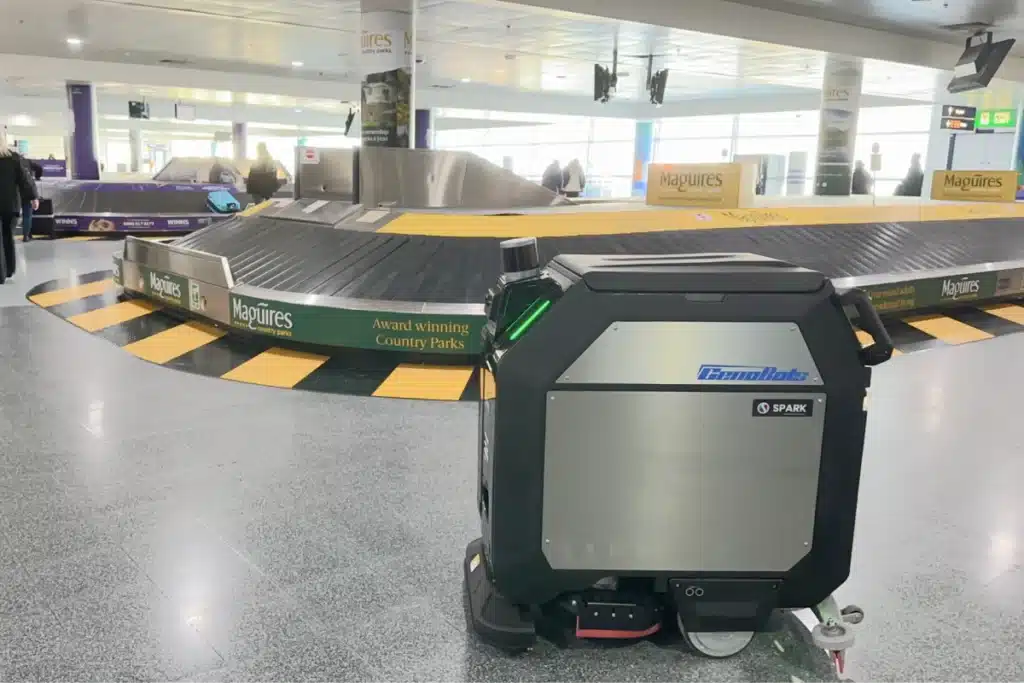
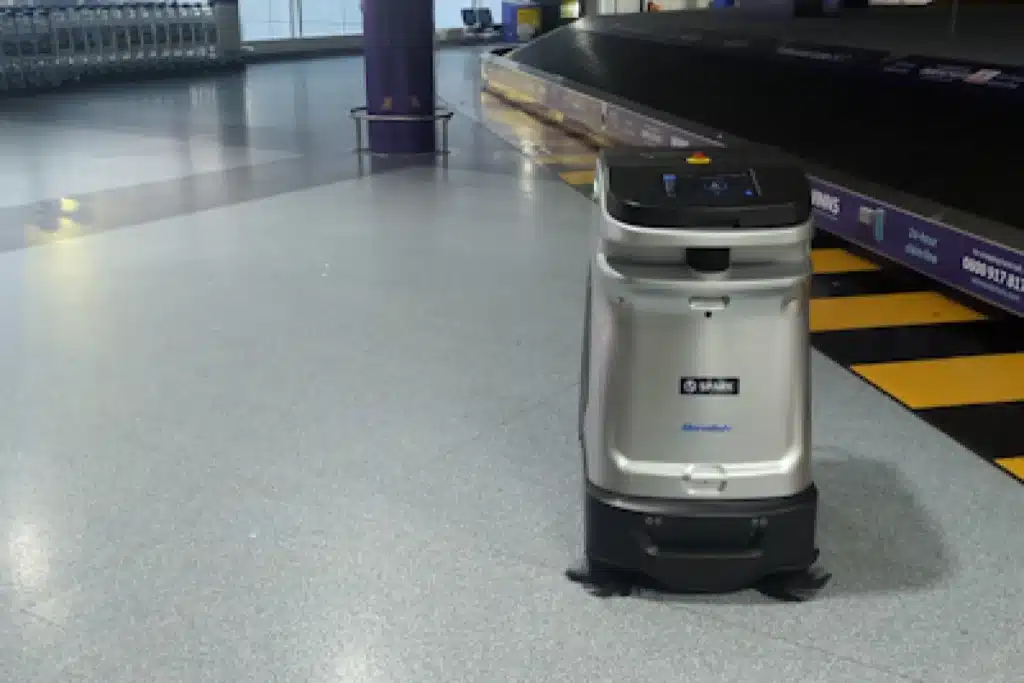
That is one reason airports have increasingly adopted this approach. Heathrow’s autonomous cleaning deployment, for example, has been publicly described as the largest deployment of autonomous cleaning robots at any UK site, with over 20 robots in service. Heathrow says each robot can clean up to 4,800 square metres per day using advanced mapping technology and water recycling systems.
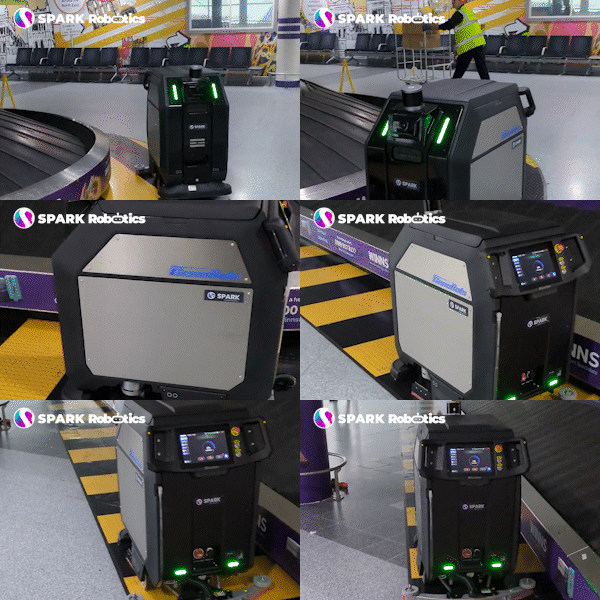
Besides Heathrow, Newcastle Airport has already deployed SPARK Cleaning Robots L50 and SP50 to practise autonomous cleaning.

Why Airports and Stations Are a Strong Fit for Autonomous Cleaning
Transport environments share several characteristics that make autonomous cleaning particularly relevant.
- They tend to have large floor areas that need repeatable coverage.
- They have extended operating hours, which means cleaning cannot rely entirely on overnight windows.
- They have constant public visibility, so cleaning standards affect the passenger experience directly.
- They often face pressure to improve efficiency without compromising service levels. Autonomous cleaning addresses those pressures best where routine floor maintenance needs to happen frequently and consistently.
Cleaner Floors Without Greater Disruption
One of the strongest arguments for autonomous cleaning in airports and stations is that it supports cleanliness without adding unnecessary interruption to the environment.
In airports and stations, cleaning teams cannot always wait for ideal conditions. Passengers are moving through departures, arrivals, ticket halls, platforms, and concourses throughout the day. Cleaning still has to happen, but it has to happen in a way that works with the site rather than against it.
That is where autonomous cleaning can offer practical value. Used correctly, it helps keep floor care moving in the background while reducing the amount of repetitive manual intervention required in the most visible areas.
This is not only a productivity issue. It is also a presentation issue. Cleaner floors delivered more consistently can support a safer and more professional passenger environment, especially in spaces where appearance, hygiene, and public confidence are closely connected.
Why Sustainability Is Also Part of the Consideration
Cleaning in transport is not only about appearance and labour. Sustainability is becoming a bigger factor too. The British Cleaning Council notes that, with the UK Government’s net zero target for 2050, contractors are increasingly expected to demonstrate clear sustainability credentials to clients. It also points to growing investment in digital technologies and robotics across the cleaning and facilities management sector.
That matters in airports and stations because cleaning happens at scale. Small improvements in resource efficiency can become significant when applied across large footprints and repeated cleaning cycles. For transport operators, this means autonomous cleaning can support more than labour efficiency. It can also become part of a wider effort to improve how resources are used across day to day operations.
Why This Matters for the Transport Sectors
For airport and station operators, autonomous cleaning should not be viewed as a technology story first. It should be viewed as an operations story.
It is about how to maintain visible standards across large public spaces. It is about how to support cleaning teams under labour pressure. It is about how to improve consistency without increasing disruption. And increasingly, it is about how to do all of that in a way that supports broader efficiency and sustainability goals.
That is why autonomous cleaning is becoming more relevant in transport. Not because it is new, but because it answers a set of practical challenges that transport environments deal with every day.
See What Autonomous Cleaning Could Look Like in Your Transport Environment
If your airport, station, or transport hub is reviewing how to improve cleaning consistency, support teams more effectively, and reduce operational friction across high footfall areas, autonomous cleaning is worth exploring in a real working context.
Speak to SPARK Robotics to explore how autonomous cleaning could support cleaner, safer, and more efficient operations across your transport environment